Featured
Posted by Kathy Brodie on December 13, 2008.
 I read with no surprise the results from the Unicef report, and the resultant reporting in the Times yesterday (11th December 2008). When all the hype and comment has been cleaned away the nugget of truth left is that a child from a disadvantaged background does not benefit from poor quality day care. Hardly earth shattering. Maria Montessori had spotted this over 100years ago. More recently the EPPE research has proved it.
The interesting part for me was that the Times had chosen to dedicate two full pages and a half page of comment to this. There were even references to research – EPPE appears on both for and against childcare, again demonstrating a balanced piece of research. You do have to read to the penultimate paragraph before you come to the obvious conclusion –
“Either the Government must help these mothers to recognise that looking after their young children is a serious job or they must provide these children from deprived backgrounds with highly skilled, well-paid nursery teachers who can help to improve their chances in life not damage them.” http://www.timesonline.co.uk/tol/comment/columnists/guest_contributors/article5321347.ece
(As an EYP I am assuming here that the author, Alice Thomson, is referring to a ‘teacher’ as all those who educate and care for early years children).
This did give me great hope that the discussion about early years education is becoming news worthy and of interest to the general public. If nothing else it prompts the questions which may be asked by parents – is my nursery/childcare arrangement of sufficiently good quality? Of course, demographics tell us that those parents who are most likely to be reading the Times have already worked this out for themselves. Those parents who need the help to identify a quality setting have been missed again.
Featured
Posted byKathy Brodie on December 13, 2008.


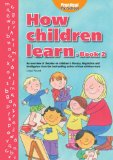
As the title suggests this is the follow on book from How Children Learn by Linda Pound and is laid out in the same style, with key dates in the side margins and good, clear headings. The references are many and varied, and, more importantly, easy to find!
The major difference with this book is the depth of the content. As well as an overview Linda goes into more detail about the development of each theory, how they build on each other and they differ. I found the way that phonics, in various forms, has been in and out of fashion since the middle of the nineteeth century fascinating – there is a particularly good table which compares analytic phonics with synthetic phonics in the chapter about how children learn to read and write.
In the chapter about intelligence there are some mind blowing facts:
- The first series of tests for children, to see if they would benefit with mainstream schooling, were devised in 1905 (Simon-Binet tests). And I thought SATS were a modern demon!
- In 1967 Joy Paul Guilford suggested there are 120 elements which make up human intelligence.
- Scores in intelligence tests have been rising ever since they started (the Flynn Effect) – no-one is totally sure why.
Creativity is explored in the long view, from Freud to Pinker to Csikszentmihalyi, and then applied to the educational approaches. I found that this really made me think about what creativity is and why it is so important – and also why we don’t foster it more in our practitioners.
Conversely when Linda discusses progressive twentieth century theorists I felt that I had seen it somewhere before “individuality, freedom and growth”,”learning rather than teaching” and “a child’s life under his own direction is conducted all in play, whatever else we want to interst him in should be carried on in that medium”. The EYFS, maybe? No, progressive thinkers before the second world war.
The book ends on an overview of how children learn to talk including a very useful section on early years research.
Overall I would thoroughly recommend this book, especially if you have a particular interest in literacy, linguistics and intelligence or even if you have ever just thought ‘why do we do it like this?’.
Unlike book one, which I enjoyed as an interesting and informative read, I found this one really had me thinking and questioning my assumptions on phonics, creativity and intelligence. Linda deals with complex subjects and interwoven threads of theories comprehensively but clearly. It has inspired me to revisit theorists with a new outlook, particularly Gardner and Csikszentmihalyi, and has made me realise there is very little which is brand new in education!
Featured
Posted byKathy Brodie on December 5, 2008.

At a recent conference about children’s thinking the presenter, the acclaimed author Marion Dowling, made a comment about why it is so important that we should understand children’s thinking processes and how we can then use this in our work. As she stated – “we can’t compel children to engage”. I’m sure every practitioner can empathise with this, having sat in front of a group of children with a book and knowing that not every child is listening!
Marion then went on to describe a situation she had observed in a reception class, who had been learning about Goldilocks and the three bears. When it was time to review their learning the teacher didn’t fire questions at the children but chose to dress up as ‘Mrs Locks’ who had lost her daughter ‘Goldie’.
Click here for more »


 Kathy Brodie on December 13, 2008.
 I read with no surprise the results from the Unicef report, and the resultant reporting in the Times yesterday (11th December 2008). When all the hype and comment has been cleaned away the nugget of truth left is that a child from a disadvantaged background does not benefit from poor quality day care. Hardly earth shattering. Maria Montessori had spotted this over 100years ago. More recently the EPPE research has proved it.